
Overview
Near-term hangar slots are not the same problem as a five-year maintenance wave plan. AirOS Long-term Capacity is a multi-year planning workspace for programme what-ifs, hangar pressure, cost, and powerplant or LLP coverage — without replacing regulatory compliance recalculation or your approved maintenance programme. It is not the operational calendar (Schedule), the constraint solver (Scheduling Engine), or personnel shifts (Roster).
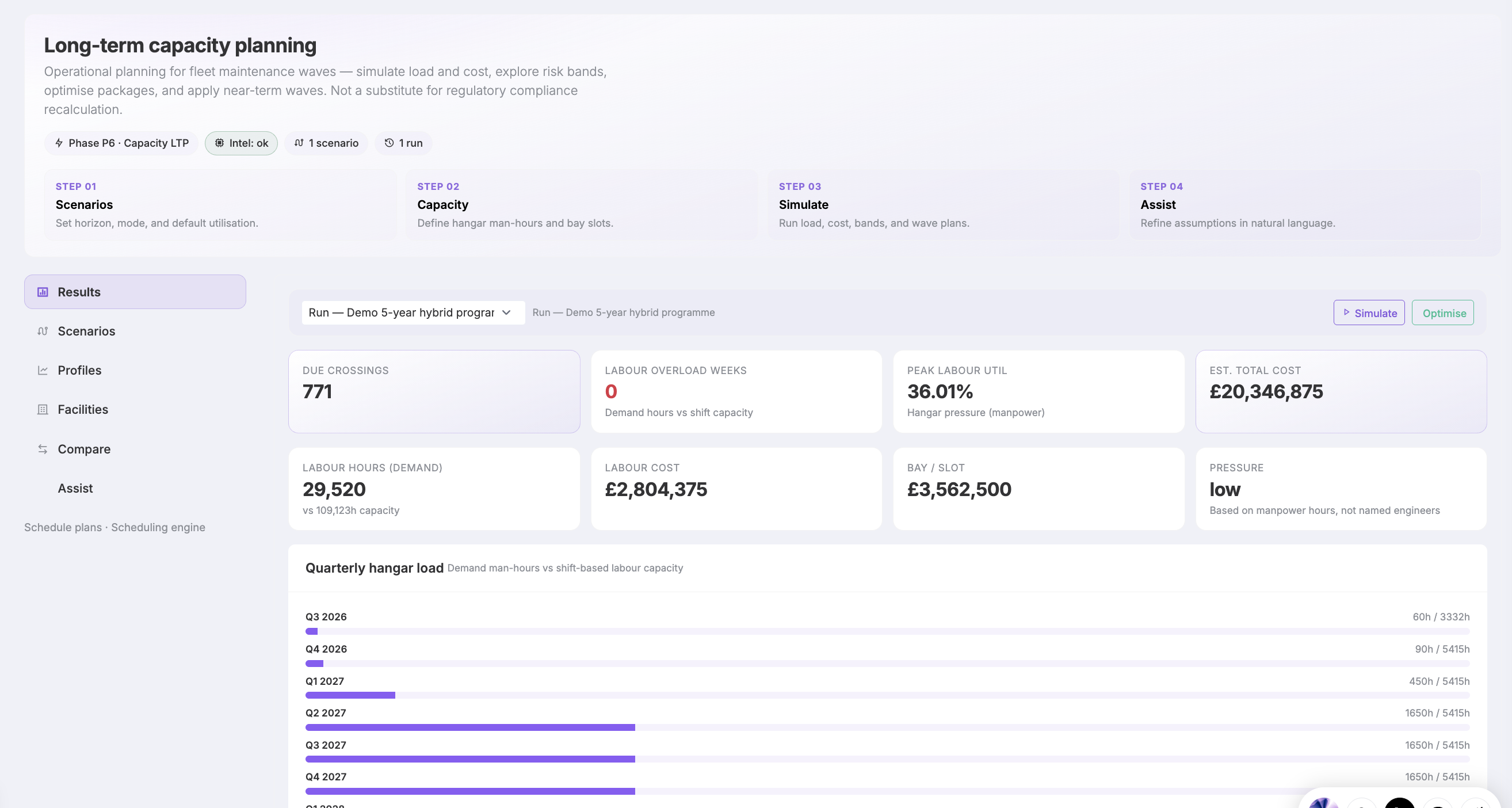
Hangar pressure is demand man-hours divided by available labour hours from facility shifts and headcount — not named engineer assignment months ahead. Simulate against utilisation profiles, the live schedule plan, or a hybrid. Optimise packages into waves under hangar capacity (constraint solving with a simpler fallback if needed), then apply the next 90 days as draft maintenance blocks on the operational schedule.
Capacity Assist can answer what-if questions and propose plan changes for the planner to apply before committing.
Features
- Multi-year scenarios: Programme what-ifs with utilisation profiles, schedule-plan, or hybrid simulation
- Hangar pressure: Demand man-hours versus facility shift × headcount labour — quarterly load and overload KPIs
- Optimised maintenance waves: Pack dues into waves under hangar capacity, then apply the next 90 days to the live schedule
- Cost & skill hours: Labour, bay, parts, and downtime KPIs with quarterly cost and skill-hour demand
- Powerplant & LLP: Removal timeline, spare pool coverage, and lease / EIS / EOL scenario fields
- Risk bands & shocks: Best / likely / worst availability plus bay-offline, utilisation, and shop-TAT templates
- Capacity Assist: Ask what-if questions, review suggested plan changes, and re-simulate before committing the plan