Airworthiness Review (ARC)

Part-M / Part-CAMO airworthiness review certificates — in-fleet reviews, ARC-as-a-service document onboarding, findings, authorised reviewer sign-off with certification PIN, and audit-ready reports.

Overview

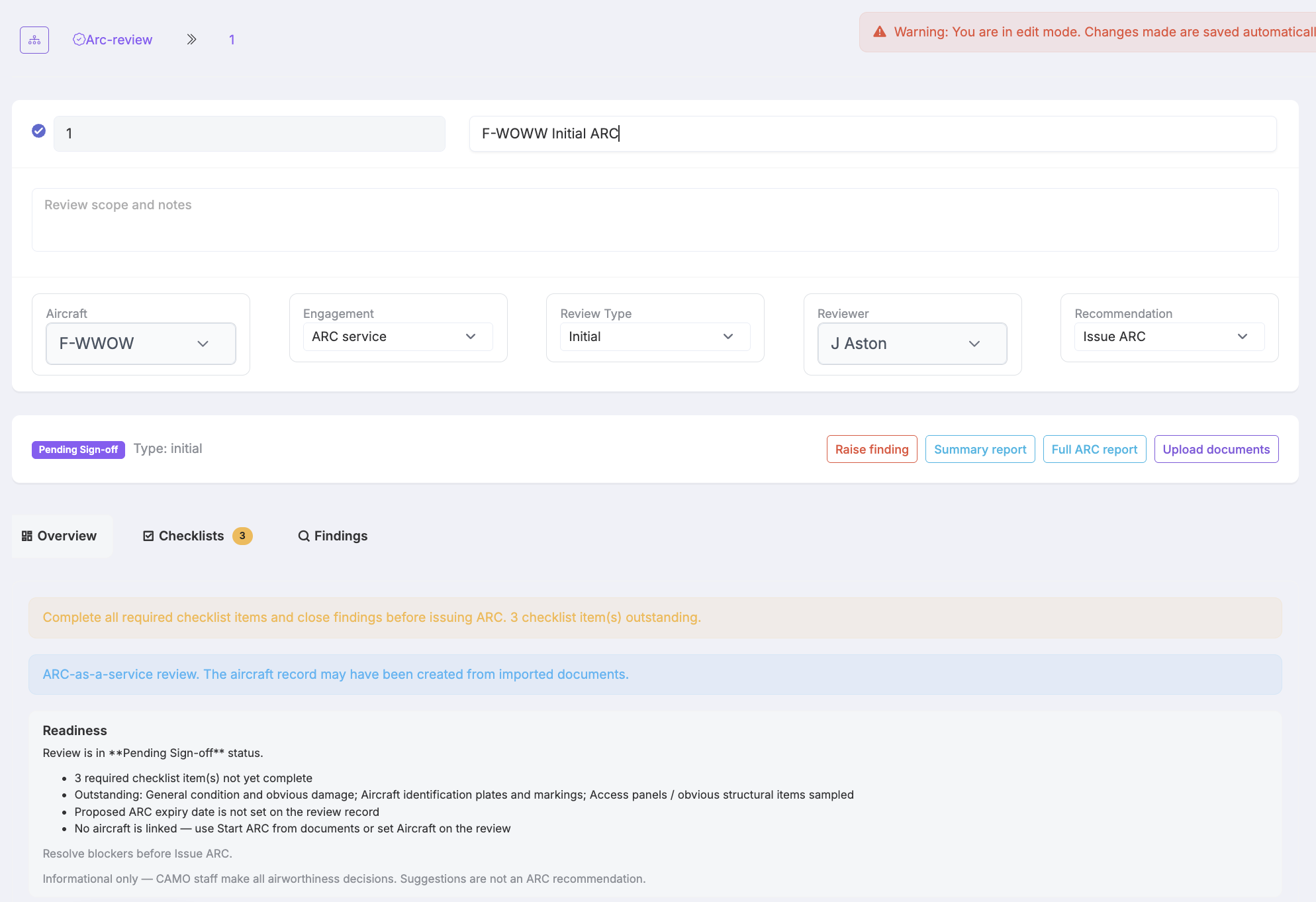
Airworthiness Review Certificates are a continuing airworthiness obligation, not a paperwork exercise. AirOS ARC Reviews give CAMOs a structured M.A.901 / Part-CAMO workflow: pre-review data packs from live defects, overdue compliance and components; documental and physical survey checklists; AD/SB qualifying checks against the airworthiness directives catalogue; findings with disposition; then authorised reviewer sign-off. Issuance records the reviewer, uses their certification PIN as authentication, writes an audit history, and updates the aircraft airworthiness-review record.

For aircraft you do not manage day-to-day, start ARC-as-a-service from operator technical-file documents. OCR classifies identity, Form 1 / log cards, equipment lists, hours and cycles, AMP/AD status and work packages — then creates or updates the aircraft, installs components, and opens the review with an evidence pack. Native EFB document scanning feeds the same import.

Tablet-first checklists and findings support hangar and ramp surveys. Summary and full ARC reports freeze evidence used at issue. AD/SB checks assist the reviewer; they are not an automatic ARC decision.
Airworthiness Review (ARC)

Features

  • In-fleet pre-review pack: Live defects, overdue compliance, and component picture attached to the aircraft before the survey starts
  • ARC-as-a-service onboarding: Start a review from operator technical-file PDFs or ZIP — OCR classifies documents and builds the aircraft evidence pack
  • EFB document scanner: Native camera scan with page detect and crop adds PDFs to the same ARC import from the hangar floor
  • Documental & physical checklists: Hangar-ready tabs with large tap targets; evidence-based ticks must be confirmed by the reviewer
  • AD/SB qualifying checks: Outstanding catalogue ADs (and linked SB/modification status used in the check) block ARC readiness until each item is complied, marked not applicable, or embodied via a linked certified modification. Recurring or due-dated programme tasks remain on the maintenance forecast — this check is AD/SB catalogue state, not a substitute for AMP due items.
  • Findings & sign-off: Raise findings from suggestions or survey notes, disposition blockers, then request CAMO sign-off
  • Authorised issuance: An authorised reviewer signs off the ARC; the certification PIN authenticates that person, the action is written to audit history, and the aircraft record is updated
  • Summary & full reports: Printable reports that freeze identity, recommendation, checklists, findings, and OCR evidence used at issue

From evidence pack to issued ARC

An airworthiness review should inspect the continuing airworthiness record you already keep — not a folder assembled the week before the surveyor arrives. Airworthiness Review (ARC) in AirOS is a Part-M M.A.901 / Part-CAMO workflow on live aircraft data.

Two ways to start

  • In-fleet CAMO — create a review on an aircraft you already manage. The pre-review pack reads defects, overdue compliance, and components as they stand today. Upload the technical file to build the document picture; AirOS highlights differences with the live record and does not overwrite aircraft or components.
  • ARC-as-a-service — the aircraft is not on this CAMO. Start from operator technical-file documents. Identify whether the aircraft is inside or outside a controlled environment (same CAMO), whether a CAA recommendation or self-issue can be carried out, and the review from–to dates. OCR classifies identity, Form 1 / log cards, equipment lists, hours and cycles, AMP/AD status, and work packages, then opens the review with an evidence pack. The native app can scan pages into the same import.

Empty defect or compliance counts after document import mean those records were not in AirOS. They are not proof of a clean aircraft.

Building the picture

Select a work package to see related tech-log pages, issued parts, and Form 1 / 8130-3 certificates. Matching uses work-order citations and part number / serial number, so a certificate hundreds of pages later still joins the issued part. Each Form 1 is checked for EASA / CAA / FAA release, new vs repaired vs overhauled, and authorised release. Staff then mark the document compliant. The check is assistance — AirOS does not auto-issue an ARC.

What the reviewer confirms

Documental and physical survey checklists are hangar-ready tabs. Evidence-based ticks can be applied, then must be confirmed. AD/SB qualifying checks read the Airworthiness Directives catalogue — outstanding items block readiness and appear as suggested findings.

Findings are dispositioned, authorised reviewer sign-off is requested, and the ARC is issued with the reviewer’s certification PIN as authentication — or a CAA recommendation is recorded when the aircraft is outside a controlled environment. The action is written to audit history. Summary and full reports freeze the evidence used at issue, including every OCR document that built the picture.

ARC integrates with Aircraft, Maintenance, Modifications, and Document Control so issuance updates the same record dispatch and CAMO already trust.