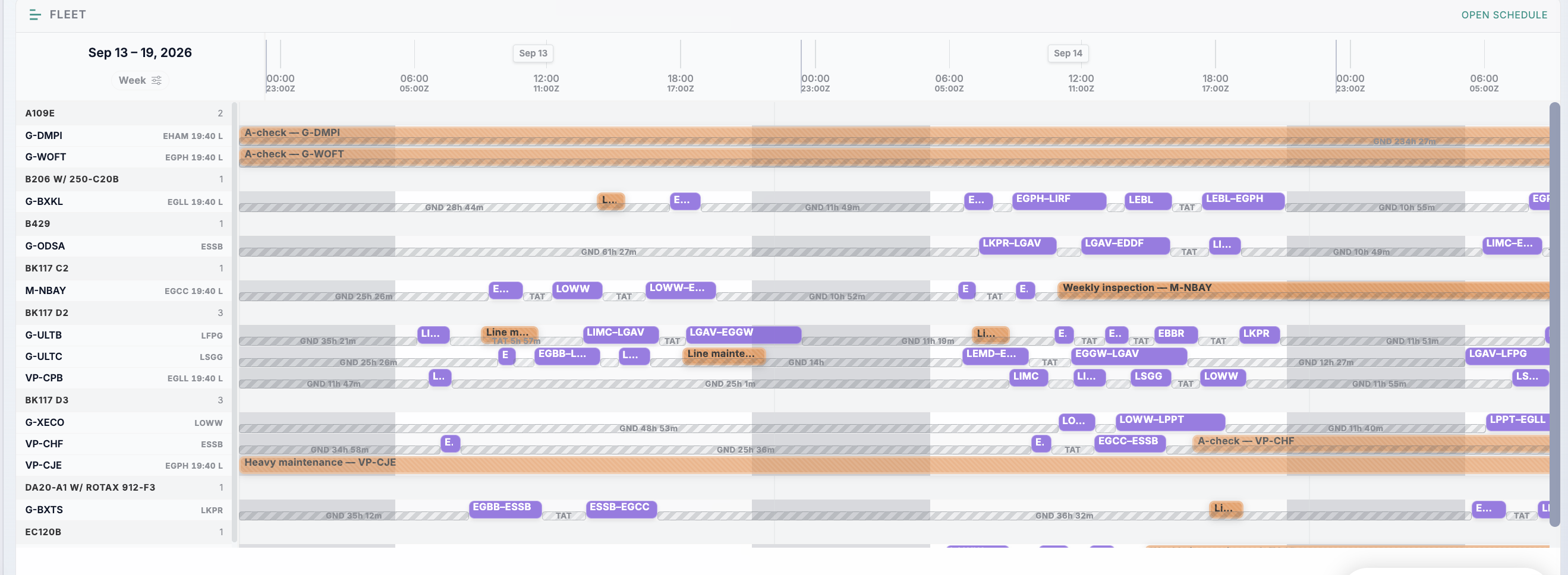
One calendar for flights, maintenance, and crew
Flight operations, maintenance planning, and crew rostering rarely fail because teams lack effort — they fail because each department maintains its own version of availability. AirOS Schedule is integrated operational and maintenance planning: one calendar where aircraft status, Part-145 work packages, hangar capacity, engineer skills, and crew qualifications are constraints on the same timeline.
Dispatch, CAMO, and maintenance control work from the same data instead of reconciling overnight exports before every planning meeting. Reduce downtime by balancing maintenance requirements, engineer availability, hangar bays, and commercial flying in a single environment — with draft plans, clash detection, and real-time updates before anything is published to the live fleet calendar.
What is aviation scheduling?
Aviation scheduling aligns aircraft availability, maintenance requirements, crew qualifications, and operational constraints into a plan that can be published, audited, and executed. Unlike generic project tools, it must respect airworthiness limits, flight time limitations (FTL), type ratings, hangar capacity, tooling, and the commercial commitments tied to each airframe.
Effective fleet planning starts with an honest picture of what each aircraft can do: open defects, upcoming compliance due items, embodied modifications, and projected utilisation from the flight programme. Maintenance planners reserve hangar slots before due dates become ramp risk. Crew planners assign qualified personnel within duty and rest limits. Operations control sees clashes — double-booked aircraft, overlapping bays, engineers on two jobs, crews approaching FTL — while the plan is still a draft.
AirOS Schedule treats these as one problem. Flight scheduling, CAMO planning, MRO workload, and engineer rostering share the same operational model as Maintenance, Aircraft, and Users.
Built for your organisation
- CAMOs — Continuing airworthiness planning with schedule-driven maintenance forecast, compliance projection from flight programmes, and hangar windows reserved before due items slip.
- Part-145 organisations — Work package alignment, engineer rostering by skill and certification, and hangar slot planning alongside line maintenance.
- Operators — Aircraft utilisation planning for charter, scheduled services, and mixed fleets with real-time clash detection.
- MROs — Heavy maintenance planning, capacity modelling, and Maintrol work package integration on shared resource timelines.
- HEMS operators — Rapid replanning when aircraft, crew, and maintenance windows compete under dispatch pressure.
Plan operations and maintenance together
- Maintenance planning — Project compliance due dates from the flight programme, generate maintenance blocks on the fleet calendar, and align hangar capacity before workload becomes AOG risk.
- Maintenance slot planning — Reserve bays, line slots, and engineer teams for inspections, defect rectification, and heavy checks without double-booking the same airframe.
- Crew rostering — Assign crew by type rating, recency, and availability with FTL validation alongside roster assignments.
- Predicted arrivals — When a live ETA is not available, landing time is estimated from type cruise speed and great-circle distance — the same prediction crews see on the AirOS App.
- Hangar capacity — Model bay occupancy, filter by location and skill, and surface conflicts when commercial flying competes with maintenance windows.
- Fleet planning — Compare draft schedule versions, branch scenarios before publish, and test commercial feasibility against maintenance due dates and crew legality.
Draft plans, clash detection, and FTL in the same view
Most legacy aviation schedulers treat the calendar as a display layer. AirOS Schedule treats it as an operational control surface:
- Resource timelines for aircraft, crew, hangar slots, and dated actions — filter by location, skill, and certification for the planning horizon that matters.
- Automatic clash detection flags overlapping flights, double-booked aircraft, hangar conflicts, and competency gaps before a draft plan goes live.
- Flight time limitations (FTL) validation runs alongside roster assignments so duty periods, rest requirements, and cumulative limits surface as scheduling conflicts — not surprises on the day of operation.
- Draft plan branching lets teams compare schedule versions, hold alternatives, and publish only when planners are satisfied.
- Real-time sync keeps dispatch, maintenance control, and crewing aligned when plans change — no waiting for overnight batch exports.
For constraint-based optimisation — OR-Tools proposals, hangar capacity modelling, and scenario branching at scale — pair Schedule with the Scheduling Engine. Optimised proposals flow back into the operational calendar your team publishes.
Schedule-driven maintenance forecast
Continuing airworthiness depends on projected utilisation as much as historical meters. When flight programmes accelerate, compliance due dates move forward — often faster than maintenance control notices in a static AMP view.
AirOS schedule-driven maintenance forecast connects the flight programme to maintenance compliance:
- Load a draft or published flight programme for an aircraft over a planning window.
- Estimate sector parameters — block hours, cycles, and landings — from historical flight data with confidence scoring.
- Simulate life-limited component meters forward, cascading utilisation from airframe to installed components.
- Project compliance due dates so planners see which inspections and MRB tasks move with increased flying.
- Generate maintenance blocks on the fleet calendar — hangar windows reserved before due items become operational risk.
This closes the loop between commercial scheduling and CAMO planning. Instead of asking maintenance control to guess utilisation from last month's averages, the forecast uses the same flight programme dispatch is building — with export to CSV for offline review and fleet-wide projection for multi-aircraft operators.
How AirOS compares
Legacy aviation systems often keep flight scheduling and maintenance planning in separate modules that sync on a delay. AirOS Schedule combines them on one calendar — with maintenance forecasting, engineer rostering, FTL checks, and optimisation built in rather than bolted on.
| Capability | AirOS Schedule | Typical legacy MIS |
|---|
| Real-time scheduling | Yes | Often batch or delayed |
| Flight and maintenance on one calendar | Yes | Usually separate modules |
| Maintenance forecast from flight programme | Yes | Varies |
| Schedule-driven compliance projection | Yes | Varies |
| AI planning assistant (AURA / Maintrol) | Yes | Uncommon |
| Resource optimisation (OR-Tools) | Yes | Varies |
| Engineer rostering by certification | Yes | Often a separate tool |
| Draft plan branching and version compare | Yes | Uncommon |
| FTL validation in the scheduling view | Yes | Separate crewing module |
| Hangar capacity planning | Yes | Basic Gantt only |
Who uses AirOS Schedule?
| Role | Typical use |
|---|
| Dispatch & operations control | Build and publish flight programmes, monitor real-time changes, resolve day-of disruptions |
| CAMO & maintenance planning | Align hangar capacity with projected due items, generate maintenance blocks from flight forecasts |
| Crewing & rostering | Validate FTL and competency flights alongside aircraft assignments |
| Commercial & charter sales | Test schedule feasibility before committing customer windows |
Integrated with the rest of AirOS
Schedule is not a standalone Gantt chart. It shares entries, permissions, and real-time events with:
- Aircraft — fleet availability, type ratings, and configuration drive what can be scheduled
- Maintenance — work packages, defects, compliance status, and Maintrol planning feed clash detection and forecast projection
- Users — crew certifications, roles, and availability underpin engineer rostering and assignment validation
- Flight Log — planned sectors link to interactive route planning and logging
- Competency — training flights and overdue competencies appear on the same timeline
- FTL — duty and rest rules validate against roster data during scheduling
- Regulation Intelligence — regulatory change awareness supports audit-ready planning decisions
- Scheduling Engine — constraint-based optimisation proposes feasible alternatives before publish
Built for regulated operations
AirOS Schedule is designed for organisations that need traceable planning decisions — draft versus published states, conflict resolution history, and maintenance blocks generated from documented flight programmes. Planners stay in control; the system surfaces constraints early so airworthiness and commercial commitments stay aligned.
For a walkthrough against your fleet types, bases, and planning horizon, contact us for a demo.