What AirOS AURA is — and what it is not
AirOS AURA (Aviation Unified Regulated Assistant) is the platform's intelligent layer across maintenance, compliance, document control, and operations. It is not a generic chatbot bolted onto legacy aviation ERP software. AURA is designed for regulated environments where engineers, CAMOs, and safety managers must retain authority over airworthiness decisions.
AURA answers questions against your organisation's live operational data — fleet records, maintenance programmes, controlled documents, and regulatory publications — with responses grounded in traceable sources. AI Import reads the same records from paper and PDF: certificates, ADs, entire aircraft files, assemblies, AMP catalogues, and completed MRO packages. Extracted product types and named registrations match your catalogue; suggested links are reviewed before save. Where recommendations affect compliance or maintenance actions, they surface through AI Inbox for explicit human approval before anything is applied.
Architecture: operational data, not isolated prompts
Most aviation AI tools treat each conversation as an isolated prompt. AURA is architected differently:
- Domain-linked context. Queries resolve against AirOS entries — aircraft, work packages, defects, documents, and compliance tasks — scoped to your organisation's permissions and regulatory framework.
- Tool-assisted retrieval. AURA uses structured tool calls to fetch current records, search controlled documentation, and cross-reference regulatory updates rather than relying on static training data alone.
- Streaming with validation. Responses stream in real time while output checks keep answers within operational boundaries — no unsupervised certification, dispatch approval, or maintenance release. Staff verify cited sources before acting.
- Audit logging. AI-assisted interactions are logged with source references so quality teams and regulators can reconstruct what information informed a decision.
This architecture aligns with EASA AI Roadmap Level 1 and Level 2 principles: AI augments human expertise; accountable persons remain responsible for outcomes.
Safety design and human-in-the-loop controls
Aviation AI must be judged by what it cannot do as much as what it can. AirOS enforces these boundaries in AURA's design:
- No autonomous airworthiness certification. AURA cannot approve maintenance release, certify work, or authorise dispatch. Certifying staff and nominated persons retain sole authority.
- Approve-or-decline recommendations. AI Inbox presents maintenance follow-ups, compliance gaps, and document actions as recommendations — never auto-applied changes. Every approval or decline is recorded with user identity and timestamp.
- Source attribution. Regulatory and operational answers cite the underlying records, publications, or procedures. Engineers can verify AI output against primary evidence before acting.
- Role-based access. AURA respects the same permission model as the rest of AirOS. Users see only the aircraft, documents, and compliance data their role permits.
- Voice assistance with operational context. Hangar voice mode supports hands-free queries during maintenance — but voice interactions follow the same validation and logging rules as text. A Hey AURA wake word starts the conversation; live tools search records, summarise the aircraft in front of you, and guide the page you are on, with cited sources in the tray.
These controls are documented in our AI Policy and expanded in the research paper Ethical AI in Aviation.
AI Import: from the paper file to the live record
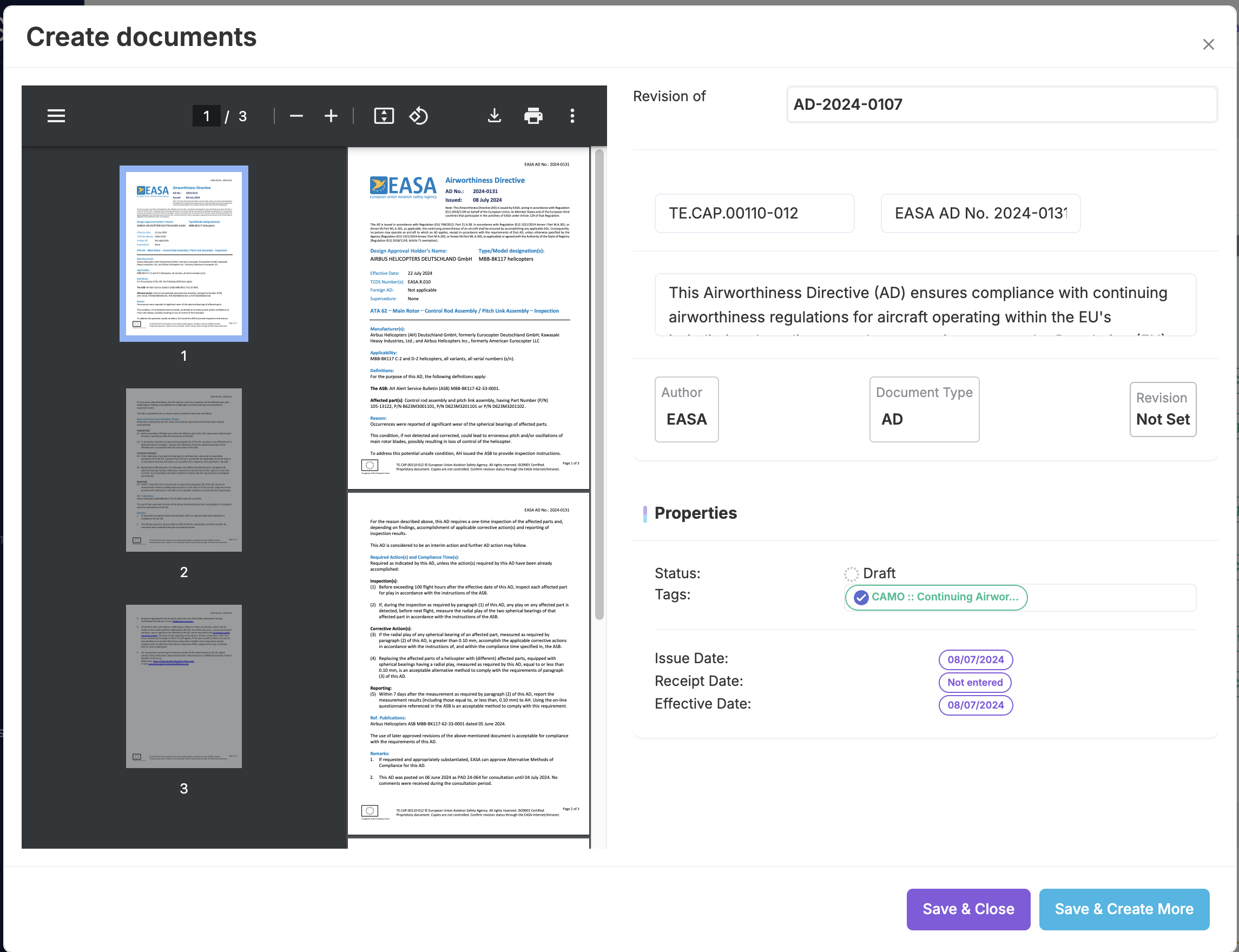
AURA is not only conversation. AI Create and specialised importers OCR operational documents and propose structured entries:
- Any domain — certificates, reports, and mixed PDFs populate fields, then present suggested catalogue links (types, aircraft, modifications, named tasks) for review. Failed or wrong drafts can be discarded without polluting the record.
- Entire aircraft file — identity, Form 1s, log cards, equipment lists, and status reports classified with specialised OCR passes.
- Assembly / engine file — nested modules, IPC lists, and TSN/CSN for engines, propellers, and APUs.
- AMP / MPD / ALS — OEM task catalogues drafted as reviewable maintenance-programme tasks.
- External MRO packages — completed offline work packs become complied tasks and defects, with optional CAMO PIN certify.
- External CAMO workscopes — planned offline CAMO work orders become open hangar packages for Part-145 execution (no CRS on import).
- Bulk manuals and Form 1s — 1000+ files with ZIP, manifest CSV, and review-before-apply.
- EFB camera scan — page-detect PDFs from the native app feed the same import queues.
Nothing is applied unsupervised. Review, edit, and save remain human steps — the same accountability model as AI Inbox.
From EASA update to assigned tasks
When a new airworthiness directive lands, Regulation Intelligence ingests it automatically. AURA analyses applicability against your fleet and maintenance programme, then AI Inbox surfaces recommended actions for your team to approve — maintenance tasks are assigned to the right aircraft with a full audit trail.
How AURA differs from legacy aviation ERP AI add-ons
Legacy aviation MRO and CAMO systems increasingly market "AI features" as add-on modules. These typically provide document search or chat interfaces disconnected from live maintenance records. AirOS AURA is native to the platform:
| Capability | Typical legacy approach | AirOS AURA |
|---|
| Data source | Static document upload or siloed module | Live operational entries across fleet, maintenance, and compliance |
| Paper-file onboarding | Manual typing or disconnected OCR | AI Import with catalogue matching, suggested links, and discard drafts |
| Recommendations | Chat suggestions without workflow | AI Inbox triage with approve/decline and audit trail |
| Regulatory monitoring | Manual AD tracking | Regulation Intelligence + AURA applicability analysis |
| Authority model | Unclear human oversight | Explicit human-in-the-loop; no autonomous release |
| Audit evidence | Conversation logs only | Linked to aircraft records, work packages, and source documents |
Human-in-the-loop by design
AI Inbox is separate from chat-style AURA. Every recommendation is presented for approve or decline with full context — engineers and managers stay accountable for airworthiness decisions. Nothing is applied without your team's explicit approval.
For organisations evaluating aviation AI platforms, the critical question is not "does it use AI?" but "can we demonstrate safe oversight, traceability, and human authority?" AirOS AURA is built to answer yes.