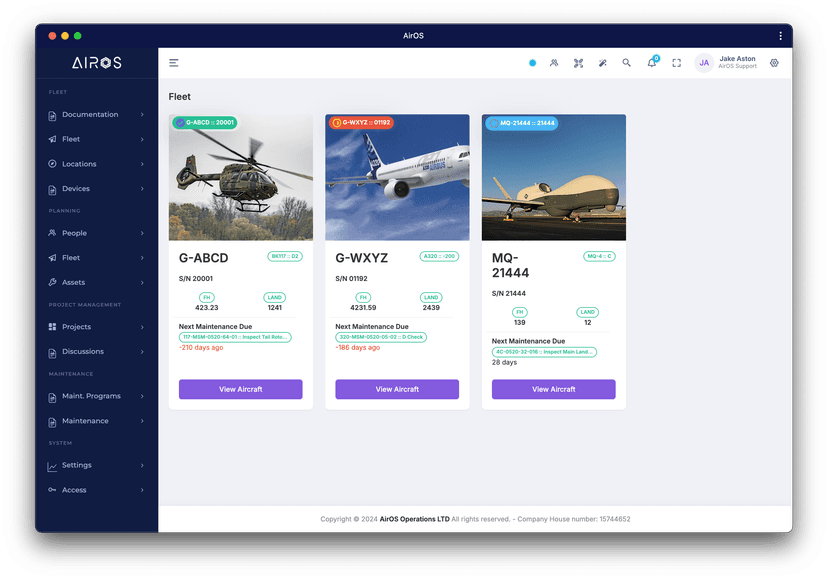
Every week, capable aviation teams lose hours to a problem that rarely appears on a risk register: three competent departments, each with a plausible plan, that cannot all be true at the same time. Commercial has sold a window. Maintenance has reserved the hangar for a scheduled inspection. Crewing has assigned a captain whose recency expires before the return leg. Individually, each decision is reasonable. Together, they are how aircraft miss slots, work packages slip, and post-event reviews begin with “we thought someone else had moved it.”
The issue is not a lack of effort. It is that flight scheduling, maintenance planning, and personnel rostering are often implemented as separate products—or worse, as separate spreadsheets—each optimised for its own department. AirOS approaches the problem differently: schedule, maintenance, and roster are domains in the same operational model, sharing aircraft availability, certifications, and live updates so planners see constraints once, not three times.
Why “integrated” has to mean more than a data feed
Many vendors offer an export from the maintenance system into a Gantt chart, or a nightly sync into crewing. That can remove double keying, but it does not remove double truth. If maintenance slips a work package by six hours and the flight schedule still shows the aircraft as available, dispatch is working from fiction until someone notices on the radio.
For Part 135 operators, helicopter EMS, and growing mixed fleets, the cost of that latency is measured in missed revenue, overtime, and the reputational damage of telling a charter client the aircraft is “probably fine.” CAMO and continuing airworthiness teams feel it as compressed planning windows and last-minute programme changes that are hard to defend in audit because the commercial record and the technical record were never the same object.
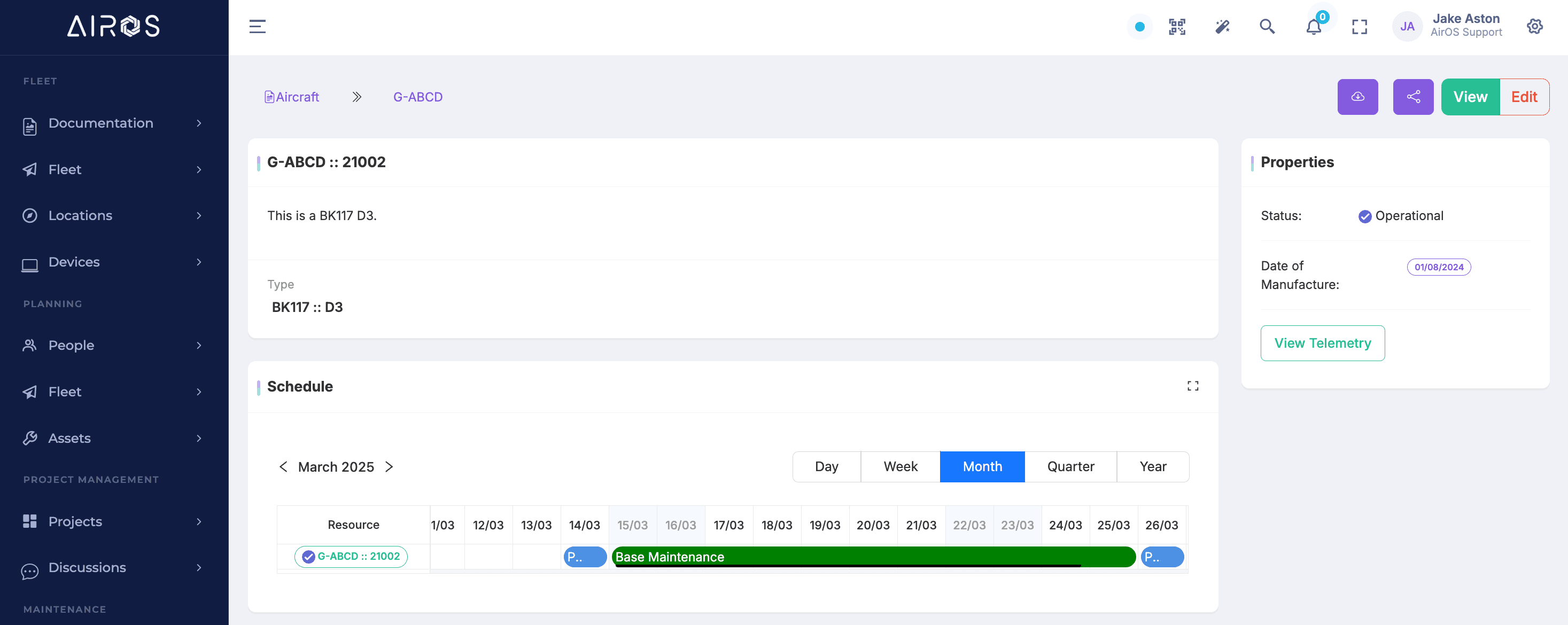
Flight slots grounded in real availability
AirOS Schedule is built for cross-department planning—not only who flies where, but what else competes for the same airframe, hangar bay, and people. Flight scheduling sits alongside maintenance events, resource allocation, and capacity forecasting so planners can see conflicts before they become AOG conversations.
- Aircraft availability that reflects maintenance intent, not just calendar colour.
- Hangar and equipment allocation when multiple work packages compete for the same capacity.
- Schedule version comparison when operations need to evaluate “plan A” against a weather or maintenance-driven “plan B.”
- Real-time updates and notifications when a task, defect, or roster change moves the boundary of what is flyable.
Location filtering and skill-efficiency views matter for operators with more than one base: the same fleet looks different depending on where engineers, tools, and certificated crew actually are, not where headquarters wishes they were.
Maintenance planning that respects the flying programme
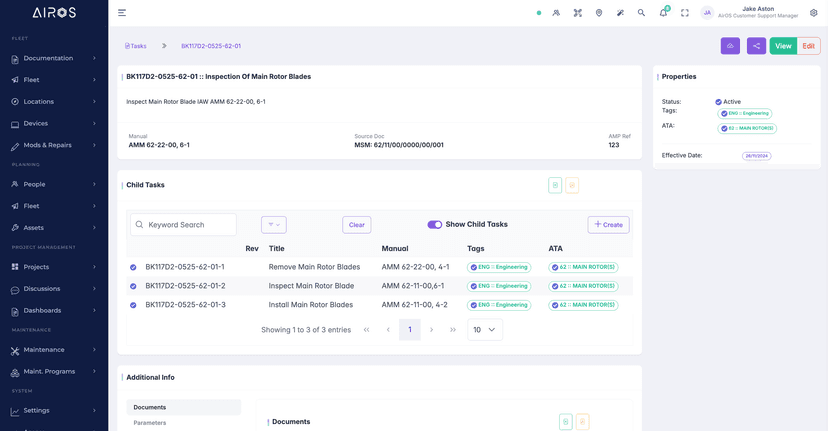
The Maintenance domain in AirOS carries work packages, programmes, defect reporting, and compliance status in the same environment as the schedule. When a scheduled inspection or defect rectification moves, the flight plan should feel that movement immediately—not after an email thread.
Maintrol—AirOS’s AI-assisted maintenance planning capability—helps teams structure work packages with task dependencies, critical-path thinking, and longer-range forecasting tied to hours and calendar limits. It is designed as decision support: engineers and planners remain accountable for release and programme changes, but they spend less time manually rebuilding dependency chains every time a slot moves.
- Work packages with visible task dependencies and blocking relationships.
- Defect reporting linked to the aircraft record, including field-friendly capture where voice or mobile input helps line crews.
- Compliance tracking with overdue projection so CAMO can see pressure building before it becomes a grounding event.
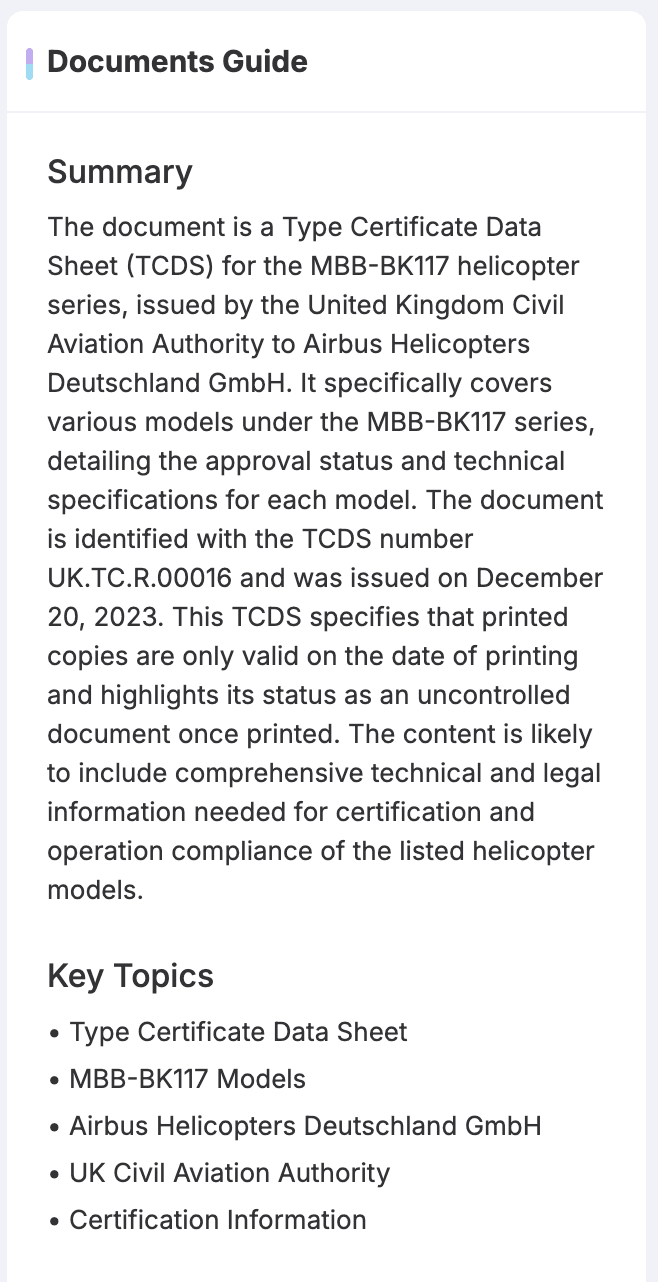
- Integration with stores and document control so parts availability and approved data sit beside the work, not in a separate tab.
Crew rostering with certifications in the loop
A schedule that ignores crew legality and type ratings is a schedule for the wall. AirOS Roster connects personnel assignments to certification and availability data so dispatch and crewing leads are not exporting rosters into side tools to answer basic questions: Who is current? Who is on call? Who is already at duty limits when we try to extend the day?
- Certification verification before assignment—not after a challenge from the pilot.
- Shift patterns, leave, and on-call coverage for mixed operational models.
- Workload balancing and cross-department sharing when engineers and flight crew support the same peak.
- Compliance reporting that supports fatigue and duty-time conversations with evidence, not memory.
When commercial pressure meets technical reality
Charter and ad-hoc operators feel this tension most acutely: sales needs a fast quote, maintenance needs an honest answer on due items, and dispatch needs both within minutes. AirOS supports integrated booking and operational workflows so a commercial commitment can be tested against maintenance due dates and schedule capacity before it becomes a customer promise. The goal is not to slow sales—it is to stop selling aircraft time that the approved programme cannot support.
That same coupling helps after the sale: mass and balance, flight log capture, and FDM-informed insight can sit on the same aircraft record, giving post-flight analysis a path back into planning without reconstructing the day from three exports.
What to ask in a platform evaluation
If you are reviewing aviation operations software, resist the demo that stays inside one department. Ask for a single scenario, live:
- Move a scheduled maintenance input and show how aircraft availability changes for tomorrow’s revenue flights.
- Assign a crew member and surface a certification or duty conflict before the slot is saved.
- Open the defect raised on the line and trace it through to the work package and schedule block.
- Compare two schedule versions and explain which commercial or maintenance assumption changed.
The answers tell you whether the vendor has built a planning fabric or a collection of well-designed screens. Aviation professionals deserve the former—especially as fleets grow and the margin for informal coordination disappears.
AirOS is configurable by domain, permissions, and workflow so your approved processes remain yours. If you would like to walk through schedule, maintenance, and roster against your operating model, contact us for a demo—we will use your aircraft types, bases, and typical planning horizon so you can judge fit on evidence, not slideware.