Charter sales closes a week of additional sectors. Dispatch publishes the revised programme on Tuesday. By Thursday, maintenance control is fielding questions about an inspection that was comfortably two weeks out on Monday—and is now inside the flying window. Nobody changed the approved maintenance programme. The aircraft simply flew more than the plan assumed.
Continuing airworthiness depends on projected utilisation as much as historical meters. When flight programmes accelerate, calendar and life-limited due items move forward. The failure mode is familiar: CAMO teams forecast from last month’s averages while commercial scheduling works from next month’s revenue opportunity. Both groups are doing their jobs. They are just not looking at the same future.
AirOS schedule-driven maintenance forecast closes that gap. It takes the draft or published flight programme your dispatch team is already building, estimates sector parameters from historical flight data, simulates component and airframe meters forward, projects compliance due dates, and generates maintenance blocks on the fleet calendar—so hangar windows are reserved before due items become operational risk.
Why static AMP views fall behind a moving programme
Most maintenance information systems show due items against current meters and a generic utilisation assumption. That works when flying is steady. It breaks when programmes change week to week—which is normal for charter, HEMS, seasonal tour operators, and any organisation recovering capacity after downtime.
- Calendar-based tasks look safe until projected block hours from the new programme pull them inside the window.
- Life-limited components on multiple tails drift at different rates; fleet-level spreadsheets rarely cascade utilisation correctly.
- Maintenance control learns about pressure from line crews or dispatch, not from a forward view tied to the schedule.
- Hangar bays are booked against historical norms while the flight programme implies a heavy-check cluster nobody modelled.
- Post-event reviews cite “unforecast utilisation” because the forecast lived outside the scheduling tool.
The regulatory expectation has not changed: operators and CAMOs must plan maintenance from an approved programme with evidence that due items are managed before they become airworthiness events. The practical requirement has sharpened—programmes now move faster than monthly planning cycles.
Forecast from the programme dispatch is building
Schedule-driven maintenance forecast is not a separate spreadsheet exercise. It runs inside AirOS Schedule on the same operational calendar where flight slots, maintenance events, crew assignments, and hangar capacity already coexist. The forecast uses the flight programme as its input—not a detached utilisation guess maintained by CAMO in parallel.
1. Load a flight programme over your planning horizon
Select a draft or published programme for an aircraft across the window you need—typically weeks to months depending on your operation. Draft plans are supported so CAMO can test “what if we fly this charter block?” before commercial commits.
2. Estimate sector parameters with confidence scoring
The system derives expected block hours, cycles, and landings per sector from historical flight data on that route or mission profile. Confidence scoring helps planners judge when estimates are well supported versus when manual review is wise—short new routes and irregular operations are flagged rather than silently averaged.
3. Cascade utilisation through the airframe and components
Projected flying increments airframe meters and flows to installed life-limited components. That cascade matters for mixed fleets and leased powerplants where the limiting item is not always on the aircraft you scheduled. Planners see pressure building on the correct meter, not only the fuselage totals.
4. Project compliance due dates
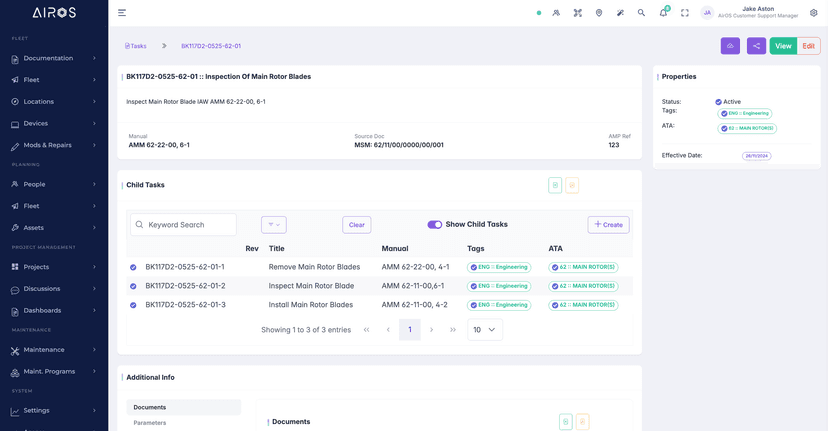
Approved maintenance programme tasks, inspections, and MRB items are evaluated against simulated meters. Tasks that were comfortably distant under last month’s assumption may move inside your planning threshold when the new programme is applied. The output is a compliance projection overlay planners can read alongside commercial flying—not a PDF emailed after the fact.
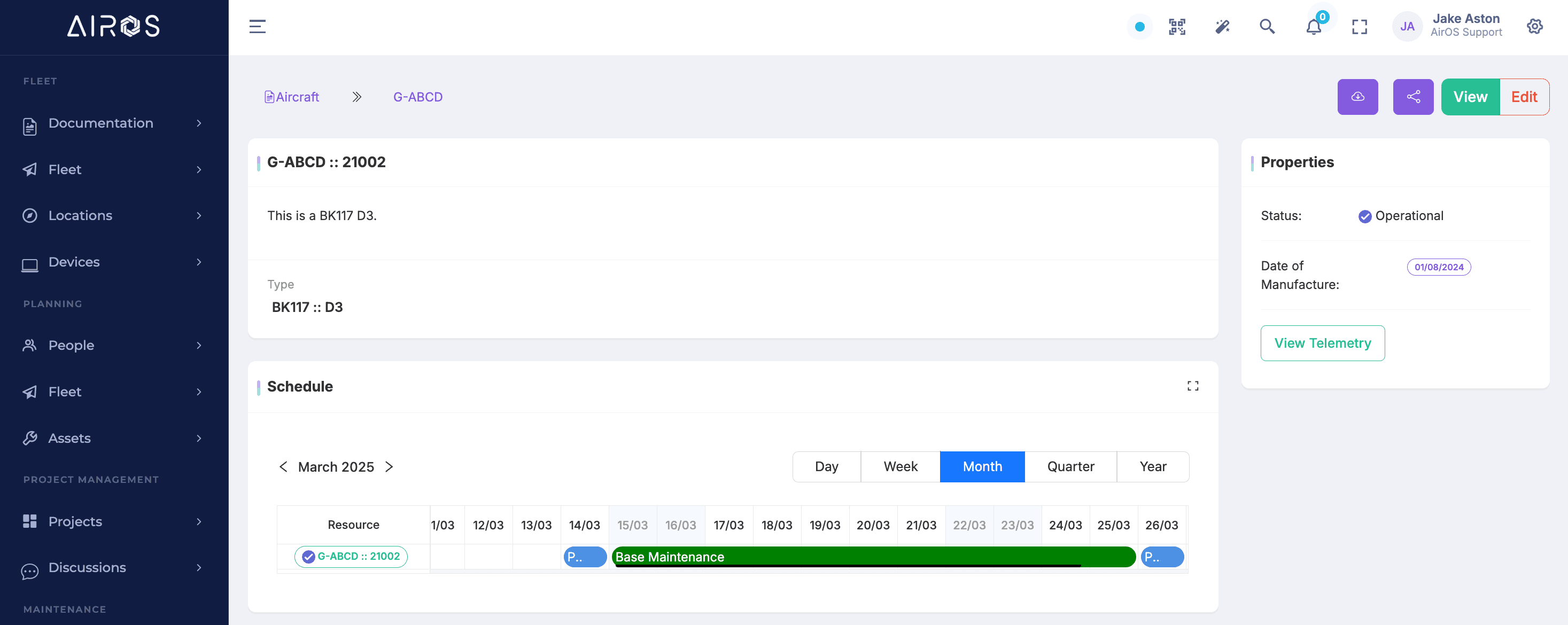
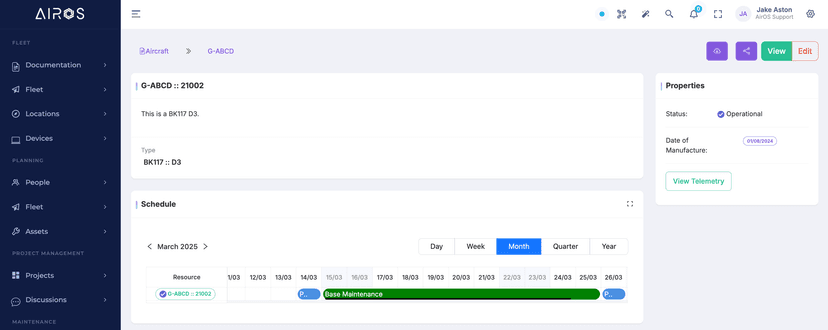
5. Generate maintenance blocks on the fleet calendar
Forecast results translate into maintenance blocks reserved on the shared schedule. Hangar bays, engineering teams, and line slots can be aligned before due items slip into dispatch conversations. Blocks link forward into Maintrol work package planning so the transition from “we need a window” to “here is the structured work” does not restart in a different tool.
One calendar, two departments, one version of the future
AirOS Schedule was already designed for integrated operational and maintenance planning—flight operations, Part-145 work packages, crew rostering, and hangar capacity on one timeline with clash detection and draft plan branching. Schedule-driven forecast adds a forward compliance lens to that same surface.
- Dispatch sees when projected maintenance pressure constrains aircraft availability for new revenue.
- CAMO sees how a commercial programme change moves due dates before the aircraft flies the extra sectors.
- Maintenance control reserves bays against forecast blocks instead of reacting when limits are already close.
- Crewing and engineering rostering can align qualifications and labour to windows that are forecast, not guessed.
- Management compares draft schedule versions with compliance impact visible—not reconstructed after publish.
This is the difference between integration as a nightly sync and integration as a shared constraint model. When maintenance slips a work package, the flight schedule should feel it immediately. When commercial adds flying, compliance projection should move in the same action—not after a manual reforecast cycle.
Fleet-wide projection for multi-aircraft operators
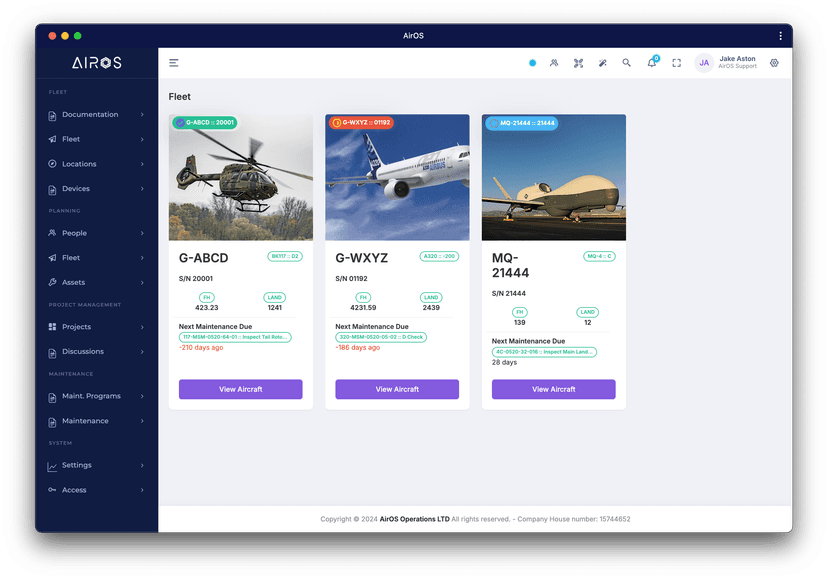
Single-aircraft forecast answers “what happens to G-ABCD if we fly this programme?” Fleet-wide projection answers the question CAMO leads actually need in weekly planning: where is pressure concentrating across the fleet, which tails compete for the same hangar week, and which due items move together when multiple programmes intensify.
AirOS supports fleet-level views and CSV export for offline review with management or external MRO partners. The export is a convenience for governance—not a substitute for the live projection on the calendar your teams publish from.
How this differs from flight data monitoring and reliability analysis
Flight data monitoring and reliability programmes answer important adjacent questions. FDM highlights parameter trends and exceedances from recorded flights. Reliability monitoring tracks defect patterns, removals, and fleet KPIs from maintenance records. Schedule-driven forecast answers a planning question upstream of both: given what we intend to fly, when will approved limits bite?
The three disciplines complement each other on the same aircraft record in AirOS. FDM may flag rising vibration; reliability may show repeat removals in the ATA chapter; the schedule forecast tells you whether added sectors this month pull the inspection forward before you commit the aircraft. Engineering reviews that start from all three signals are shorter and more defensible than reviews that stitch together exports from separate departments.
Pairing forecast with optimisation when plans get complex
Forecast shows where pressure will build. Optimisation helps you rearrange the plan when constraints collide. AirOS Scheduling Engine uses OR-Tools constraint solving to propose fleet and maintenance schedules that respect certifications, hangar capacity, and operational rules—branching scenarios like version control before you publish.
In practice, CAMO and planning teams use forecast to see the compliance consequence of a programme, then invoke optimisation when multiple aircraft, bays, and crew lines need a feasible rearrangement. Proposals flow back into the operational calendar Schedule publishes—so the loop from projection to decision to published plan stays inside one platform.
Practical adoption for CAMO and planning leads
- Agree the planning horizon your operation needs—charter and HEMS often require shorter, more frequent forecast cycles than stable scheduled services.
- Validate historical sector estimates on representative routes before trusting projection on new commercial opportunities.
- Define who may run forecast on draft programmes versus published schedules, so commercial experiments do not confuse line crews.
- Connect maintenance block generation to your hangar booking discipline—blocks should mean bays and labour are genuinely reserved.
- Review fleet-wide projection in the same meeting where dispatch presents programme changes, not as a separate CAMO-only ritual.
What to ask when you evaluate maintenance forecasting
Vendors will happily show a chart of projected hours. Aviation professionals should ask sharper questions:
- Does the forecast consume the same flight programme dispatch publishes, or a parallel utilisation file CAMO must maintain?
- Are life-limited components cascaded from airframe projection, or only fuselage totals updated?
- Do projected due dates write back to the maintenance calendar as reservable blocks, or remain a read-only report?
- Can you run the forecast on a draft schedule version before commercial commitment?
- What happens when the programme changes mid-week—does compliance projection update in real time or on batch?
Strong answers tie forecast to the scheduling surface your organisation already uses to commit aircraft—not to a side module that recreates the planning problem in another format.
If you would like to walk through schedule-driven maintenance forecast against your fleet types, typical programmes, and hangar model, contact us for a demo. We will use your operating pattern so you can judge whether projected due dates and maintenance blocks reflect the way your CAMO and dispatch teams actually plan—not a generic airline scenario.